AI Bot vs. Regular Chatbot: Why Old-School Bots Frustrate Customers (And What Changed)
 By Tal Shmini
A Familiar Scene: "To Return to the Main Menu, Press Star"
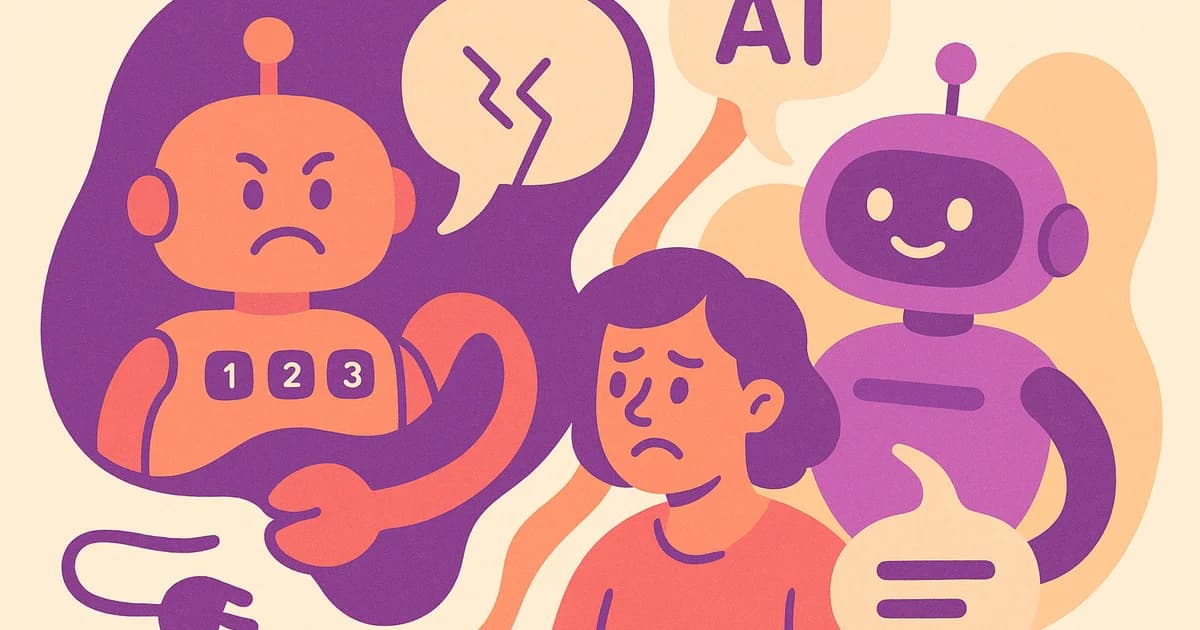
We've all been there. You message a business on WhatsApp or a website chat, and instead of an answer you get a menu: "Press 1 for product info, 2 for pricing, 3 for support." You pick 3, get a submenu. You type something that doesn't match any of the options - and the bot loops back to the same question, until you give up and go hunting for a human's phone number.
That's not a bad experience by accident. It's predictable behavior from a specific type of bot - and that's exactly what this article explains: the real difference between those frustrating bots and a conversational AI bot, why it matters for your business, and when the simple bot is actually the right choice.
What's the Difference Between an AI Bot and a Regular Chatbot?
In short: a regular (rule-based) chatbot runs on a closed decision tree - it recognizes a keyword or a choice from a limited set of buttons and returns a pre-written answer. A conversational AI bot, built on large language models (LLMs), understands the question in free-form language - even phrased unexpectedly, with typos or casual wording - and responds based on the context of the whole conversation, not just the last message typed.
The practical difference: with a regular chatbot, the customer has to adapt to the bot's menus. With an AI bot, the bot adapts to the customer's language.
Why Do Old-School Bots Frustrate Customers?
The problem isn't intent - it's a technical limitation. A rule-based bot only "knows" what someone pre-programmed into it. If a customer asks "can I pay in installments?" and the developer only listed the keyword "payment plan," but the question was phrased as "do you offer financing?" - the bot doesn't recognize a match and falls back to a default answer that has nothing to do with the question.
As a business grows and the range of questions widens, the list of keywords the bot "knows" becomes unmanageable. Every new question it doesn't recognize requires a manual rule update. In practice, most owners don't keep up with that, and the bot stays stuck at the same version it launched with - while customers and their questions keep evolving.
The result: a customer who feels like they're "talking to a wall," and for the business, a lost inquiry - because most customers won't bother finding a way around the bot. They just go to a competitor who answers faster.
What Changed With Conversational AI Bots
The real leap in recent years isn't "a smarter bot" in the marketing sense - it's a shift in the underlying technology. Instead of rigid rules, the bot runs on a language model trained on massive amounts of text, capable of understanding intent even as phrasing varies.
That unlocks several things a rule-based bot simply can't do:
- Context across a conversation - a customer can ask "what's the price?" and then "what does that include?", and the bot understands the second question refers to the same product without repeating the name
- Free-form replies - no need for exact keywords or button paths, including handling typos and casual phrasing
- Smart handoff to a human - instead of looping, a good AI bot recognizes when it can't help and hands off to an agent with a summary of the conversation so far, instead of leaving the customer to start over
- Easier updates - instead of programming every scenario in advance, you give the bot access to the business's current information (pricing, availability, FAQs), and it uses that in conversation
It's worth being precise here: a conversational AI bot doesn't "think" like a person, and it isn't always right. But the gap between "doesn't understand the question at all" and "understands the question and occasionally gets a small detail wrong" is the gap customers actually feel.
Tired of a bot your customers curse at and route around?
In a short consultation, we'll look at the actual inquiries coming into your business and tell you honestly whether a conversational AI bot solves it - or whether a simple bot is actually the right call for you.
AI Bot vs. Regular Chatbot: A Comparison
| Criterion | Rule-Based Chatbot | Conversational AI Bot |
|---|---|---|
| Understands free-form phrasing | No - needs exact keywords or button paths | Yes - understands intent even as phrasing varies |
| Conversation memory | Usually no - each message evaluated on its own | Yes - responds based on the full conversation |
| Setup cost | Lower, often a ready-made template | Higher, requires connecting to business data sources |
| Ongoing maintenance | Manual - every new scenario needs a rule update | Easier - relies on current information, not rigid rules |
| Best fit | Narrow, repetitive questions (hours, address, order tracking) | Sales conversations, needs discovery, complex support |
When a Simple Bot Is Still Enough - And That's Fine
It's worth being honest here: not every business needs a conversational AI bot, and not because it's "worse" - sometimes it's simply unnecessary. If most of your inquiries cluster around three or four fixed, narrow questions - hours, address, shipping status - a rule-based chatbot handles that perfectly well, at a meaningfully lower cost and with no risk of an off-target answer.
A conversational AI bot earns its cost when conversations vary: customers ask different questions, weigh options, need the bot to understand context ("and do you offer home delivery?"), or when the goal isn't just answering but moving a customer toward closing - which takes an actual conversation, not a menu.
The simple rule: the more predictable and repetitive your inquiries, the more a simple bot is enough. The more varied and understanding-dependent they are, the more a conversational AI bot pays off.
How This Plays Out for Your Business
Fast, relevant responses directly affect whether an inquiry moves forward in the sales process - that's no secret, which is why business owners are so sensitive to response time. But a "fast response" from a bot that doesn't understand the question doesn't help - it just speeds up the frustration. A customer who gets an irrelevant answer in one second still doesn't get what they need, and often leaves faster than if they'd waited for a human agent.
That's why when we build bots at Toolip, the first question isn't "which technology" but "what questions are actually coming in." Mapping a business's real inquiries - not the ones you imagine showing up - is what determines whether a simple bot is enough, or whether moving to a conversational AI bot pays for itself quickly.
Bottom Line
The difference between an AI bot and a regular chatbot isn't a matter of technology fashion - it's the difference between a bot that understands what a customer is asking and one that only recognizes words. Businesses with narrow, repetitive inquiries can stay with a simple bot without losing anything. Businesses with varied conversations, where every mishandled inquiry is a lead that goes cold, gain significantly from switching to a conversational AI bot.
Not sure which type of bot fits the inquiries actually coming into your business? Book a free consultation - we'll go through your real inquiries together and tell you honestly what's worth it and what isn't.
More articles on this topic


Related Services

Written by Tal Shmini
Founder of Toolip | Business Automation & AI
Want us to do this for you?
Let our experts handle the implementation while you focus on growing your business.