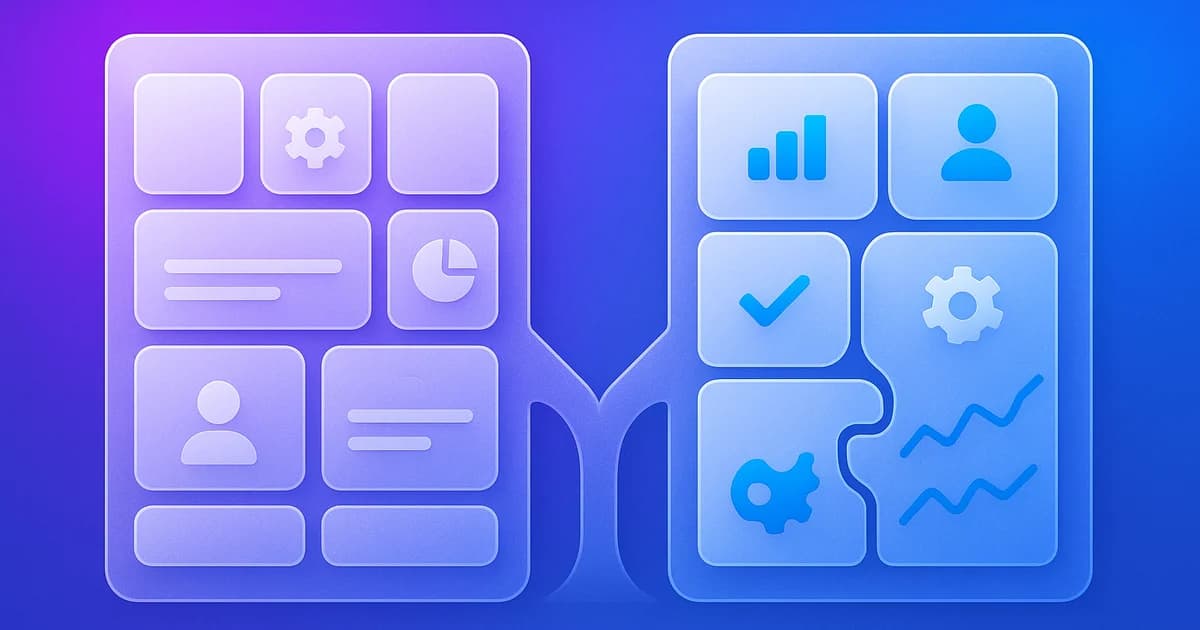
Custom CRM vs. Off-the-Shelf: How to Choose Right (Without Regretting It in a Year)
 By Tal Shmini
"So... Monday, or Something of Our Own?"
I get this question in almost every intro call. A business owner who's fed up with spreadsheets, heard about Monday from a friend, saw a HubSpot ad, and got a quote from someone offering to "build them a system." Now they're confused, and rightly so: each side is convinced its solution is the right one.
The problem is that it's the wrong question. The right question isn't "which system" but "what does my process look like, and what fits it most closely." The moment you ask it that way, the answer usually becomes obvious on its own.
Let's sort this out honestly, including the parts where off-the-shelf is the right call.
What Off-the-Shelf Platforms Do Brilliantly
Let's start here, because they've earned it: Monday, HubSpot, Pipedrive, and their peers are excellent products. There's a reason millions of businesses use them.
Speed. Sign up today, work tomorrow. No spec, no development, no waiting.
Low starting cost. Tens of dollars per user per month, with no upfront investment. For a small business watching its cash flow, that's a real advantage.
A polished interface. Hundreds of millions of dollars invested in user experience. The buttons are where you expect them and the mobile app just works.
An ecosystem. Hundreds of ready-made integrations, YouTube tutorials, support communities. Stuck? Someone got stuck before you and solved it.
If your sales process is standard - lead comes in, call, quote, close - and your team is small, an off-the-shelf platform as-is will probably serve you well. I say that as someone who makes a living building custom systems.
Where It Starts to Creak
So why consider anything else? Because there's a point where one-size-fits-all stops fitting you. The signs are familiar:
Your process doesn't fit the template. You have field agents, or production stages, or supplier approvals, or a service process that continues after the sale. You start bending the system: fields used for something other than their label, statuses with secret meanings that only people who attended the training understand. Within six months, exactly one person on the team knows how the system really works.
The subscription balloons. You started at $30 per user. Then came an automations add-on, a reporting add-on, five more users, and a plan upgrade because you ran out of records. Suddenly you're paying $1,500 a month for a system your team barely tolerates.
The integration you need doesn't exist. Global platforms connect beautifully to global tools. Connecting to your local invoicing software, your phone system, or an industry-specific interface is another story. Sometimes there's a workaround, sometimes it's fragile, and sometimes there simply isn't one.
You pay for thirty features and use five. That's not just wasted money. Every unnecessary screen is friction for your team, and friction is the number one reason CRM implementations fail.
Torn between Monday and a system of your own?
In a free discovery call we'll map your sales process and tell you honestly which direction fits, even if the answer is that an off-the-shelf tool is enough.
What "Custom" Actually Means (Hint: Not Necessarily From Scratch)
Here lies the biggest misunderstanding in the market. "Custom CRM system" sounds like a year-long software project with a six-figure budget. In reality, there's a whole spectrum:
Level 1: Off-the-shelf, deeply customized. You stay on an existing platform, but it's built properly: pipelines that mirror your business, automations that patch the gaps, connections to your tools. This is usually the most cost-effective starting point.
Level 2: A system on flexible infrastructure. Built on tools like Airtable with an automation layer on top. You get a system that behaves exactly like your process, at a sane development cost, with the flexibility to change things tomorrow.
Level 3: Fully bespoke development. Built precisely for you, including the interface, the logic, and built-in AI capabilities. Justified when the process is genuinely complex or when the system is the heart of the business.
The common mistake is thinking the choice is between "off-the-shelf as-is" and "Level 3." Most businesses I meet need Level 1 or 2, and a vendor who jumps straight to from-scratch development without checking whether an existing platform solves the problem is skipping a conversation and charging you for it.
Five Questions That Settle the Choice
Ask yourself, honestly:
- Is our process similar to most businesses in our industry? If yes, probably off-the-shelf. If you constantly find yourself telling vendors "it works differently here," probably not.
- How many tools must the system talk to? Zero to two standard ones → off-the-shelf. Four or more, including local ones → customization starts paying off.
- What will off-the-shelf cost us over three years? Multiply the expected monthly subscription (including add-ons and team growth) by 36. That number changes the comparison.
- Who on our side will maintain it? No technical person and no ongoing partner → better to stay on a well-known platform with broad support.
- Is the CRM a competitive advantage or a utility? If lead response speed and service are what set you apart, a system tailored to your process is an investment, not an expense.
An Example From the Field
A client of ours, a services business with eight employees, came to us after a year on an off-the-shelf platform. On paper everything was there. In practice: WhatsApp leads were entered manually (or not at all), the reports didn't reflect their real workflow stages, and the subscription kept climbing. We didn't replace everything: we kept the existing infrastructure, connected WhatsApp directly, rebuilt the pipeline stages around how they actually work, and added automatic call summaries. The result is a "custom CRM" in every sense, at the cost of a focused project, not a from-scratch build.
That's the point: custom isn't a product, it's an approach. You start from the process and choose the tool, not the other way around.
The Bottom Line
Off-the-shelf is the right choice when the process is standard, the team is small, and the connections are simple. Custom becomes worthwhile when the process is unique, the subscriptions balloon, or critical integrations are missing. And in most cases the best answer sits in the middle: an existing platform, deeply customized around how your business actually works.
Anyone trying to sell you one end of the spectrum without asking about your process - whether it's "just sign up for Monday" or "you have to build from scratch" - is doing you a disservice. The choice starts with the process. Always.
Still weighing which way to go? Book a free discovery call and we'll tell you honestly what fits your process - even if the answer is that an off-the-shelf tool is enough.
More articles on this topic
Related Services

Written by Tal Shmini
Founder of Toolip | Business Automation & AI
Want us to do this for you?
Let our experts handle the implementation while you focus on growing your business.